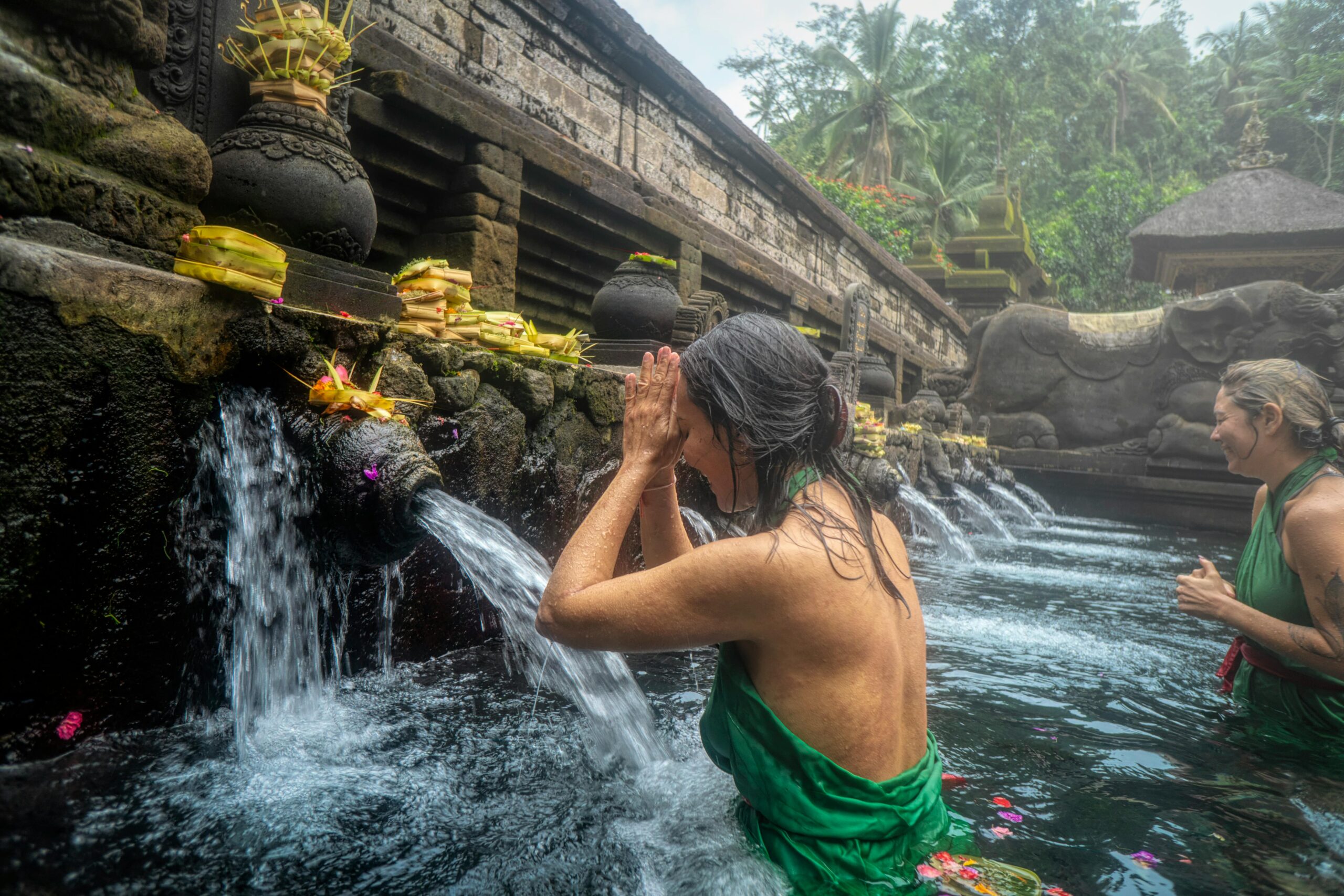

You’re at a dinner in Canggu. Everyone at the table is building something, healing something, or both.
Someone turns to you and asks what brought you to Bali. You give the version of your story that sounds right. Later, on your scooter ride home, you notice you feel more alone than you did before you went out.
That gap between the life you feel forced to perform and the life you’re actually living is something I hear about from my clients in Bali every week.
It’s more common than you’d think, and it’s worth paying attention to.
I haven’t lived in Bali, but I work with expats there regularly. They come to me from the co-working cafes of Canggu, the yoga studios of Ubud, and the cliffside villas of Uluwatu. The details of their lives vary, but the deeper patterns are remarkably consistent.
Here’s what I’ll offer in this post: an honest look at what expat life in Bali does to people, what to look for in an expat therapist, and how I work with the expats and couples who find me.
What expat life in Bali actually does to people
There is a particular version of Bali that gets marketed to the world. You probably know it all too well. The one that promises spiritual awakening, creative freedom, readily available bodywork, and laptop-on-the-beach liberation. A compelling picture, undoubtedly.
But it leaves out something important.
Namely, the promise of freedom itself becomes another pressure-laden expectation.
Let me explain what I mean (this is what I hear from my clients consistently):
The pressure to be free. Bali attracts spiritual seekers, entrepreneurs, wellness devotees, and digital nomads building a life on their own terms. At first, that energy is infectious and empowering. But subtle expectations lurk beneath it. You’re expected to feel grateful, open, and inspired. You’re expected to be healing, growing, and evolving in some visible way. You’re expected to be working on something interesting and contributing in some meaningful way.
These expectations are dressed up as liberation and personal-empowerment, but they’re there.
And that’s the trap. The demand to be free becomes its own form of unfreedom. The gap between how you actually feel (pressured) and how you think you’re supposed to feel (free and happy) grows. In that space, guilt and self-doubt creep in.
You’re supposed to be free, so when you feel trapped, you assume something is wrong with you, rather than recognizing the trap for what it is.
The depth you want is harder to find than you expected. Bali certainly attracts its fair share of open-hearted, earnest, sincere, kind people.
But it also draws people who aren’t available for the kind of relationship you’re looking for. People who want connection without commitment and intimacy without the price tag that comes with it. People who move on when things get real, who keep relationships light and transactional, who relate to you based on what you bring to the table rather than who you actually are.
Which is why my Bali-based clients consistently tell me that, although they came looking for connection with emotionally mature, self-aware people, they’re frequently left wanting.
Genuine depth and sincerity are harder to come by than the brochure suggested.
It becomes cliquey fast. Bali’s expat world is interconnected. Word can travel fast. People size each other up, and hierarchies form around who knows who, who’s building what, and who got invited where.
Because word travels fast, you might feel like each impression you make carries significant weight. You have to learn to calibrate. You try to be authentic (that’s the demand) but not too authentic, because your version might not fit the version that’s in fashion. The social stratification you moved halfway around the world to escape reconstitutes itself within months.
So with one foot you step forward, and with the other you hold back. You edit yourself just the right amount. The constant calibration is taxing, and it’s especially annoying given that it’s probably something you moved here to get away from.
The gap between how you are and how you think you should be becomes painful. When everyone around you appears to be thriving, the distance between your actual self and the self you put on display can wear on you.
This gap often becomes fuel for self-attack, frustration, shame, and collapse. After all, you’re in paradise, aren’t you? And you chose this, so you’re supposed to love it. When you don’t, guilt, doubt, and regret often set in.
I’ve lived this from a different angle in Istanbul. The pressures differ, but the core pattern is remarkably consistent across every expat community I work with: the setting promises a new chapter, and what it often delivers is the same old chapter with (hopefully) better scenery.
Relationships are transient, and that wears on you. People come and go. Constantly. Close friendships form fast and dissolve just as quickly. If you want something genuine and lasting, the revolving door can get demoralizing. You might stop investing fully because it’s just a matter of time before the next person leaves. That protective instinct makes sense, but it keeps you from the very thing you’re looking for.
Old patterns follow you. The fear of judgment, the impulse to reshape yourself to fit in, an avoidance of anything that threatens your ego – you brought these with you. Bali didn’t create them. But it does give them a convenient new costume called “freedom and spontaneity.”
People then avoid deeper emotional work in the name of this freedom and spontaneity. They call it liberation, but the freedom isn’t convincing. It’s continually undermined by the compulsion to flee from anything that gets in its way.
One client came to me after moving to Bali hoping to start fresh. For a while, it worked. He was surrounded by inspiring people, exciting projects and beautiful women who seemed interested. But over time, the old patterns resurfaced: unavailable partners, business ventures that went nowhere, wellness retreats that lifted him for a weekend and left him empty on the other side. Bali wasn’t the new chapter he thought it was. It was the same chapter, and it took honest work to understand why he kept rewriting it.
What to look for in a therapist as an expat in Bali
The wellness industry in Bali is strong. You will find everything from breathwork facilitators, to energy healers, to plant medicine ceremonies, to cacao rituals and sound baths. Some of these may genuinely help you feel something: peace, release, hope.
But feeling something and changing internally are different things. And the distinction matters.
Therapy done well gets at the patterns that run deeper than a retreat or a breathwork session can reach. The ones so familiar you don’t even recognize them. With the right therapist, those can actually change.
If you’re looking for a therapist, here’s my advice:
Find someone who knows the difference between wellness and therapy. Bali’s wellness scene blurs this line constantly. A good therapist isn’t going to tell you that your anxiety is a “frequency mismatch” or that you need to “clear your energy.” They’re going to help you understand what’s actually driving the anxiety, and work with you to change the patterns that keep it in place. That requires clinical training, not a certification from a weekend retreat.
Do this! It looks amazing. But don’t mistake it for deep therapeutic work.
Look for someone who will be honest with you. Validation has its place. But if all your therapist does is mirror your feelings back and tell you they make sense, you’ll feel heard and stay stuck. The therapist worth paying for is the one who will also tell you what they see, including the ways you contribute to your own difficulties.
Make sure they understand expat life specifically. Not in a general “moving abroad is hard” way. In a specific way: the identity shifts, the relationship strain that comes with cross-cultural life, the social performance, the grief of distance from home. If your therapist needs multiple sessions to understand why you can’t just “go back,” you’re educating them. You’re not doing therapy.
If you want a deeper look at what separates a good expat therapist from a general one, I’ve written a full guide on how to find the right expat therapist, including what to ask before you book.
Check that they’re actually licensed. Bali has a loose regulatory environment for mental health services. Not everyone offering “therapy” or “counseling” has clinical training. Look for credentials from a recognized licensing body. These include: a graduate degree in psychology or counseling, a state or national license, or supervised clinical hours. This matters far more than people realize.
Note: If you’re not based in Bali, I work with expats and digital nomads worldwide through my online expat therapy practice.
How I work
I provide online therapy for expats in Bali via secure video. Whether you’re in Ubud, Canggu, Denpasar, Uluwatu, or anywhere else on the island, we can work together.
I’m based in Istanbul, which puts me five hours behind Bali. Many of my clients there are able to have sessions in the afternoon or evening their time, and scheduling is straightforward.
My approach is psychodynamic and relational. I’m less interested in giving you coping strategies and more interested in understanding what’s actually driving the problem: the patterns you’ve built and the feelings you’ve learned to avoid. We’ll look at the ways you get in your own way without realizing it. That’s where real change happens.
I’m trained in Relational Life Therapy and PACT for couples work, and I’m currently deepening my training in ISTDP, an intensive form of therapy designed to help people quickly recognize and overcome the defensive patterns that generate their suffering.
I’m direct. I’ll tell you what I see. I’ll encourage you to choose getting better over temporarily feeling better in the moment. That’s not always comfortable, but my clients will tell you it’s worth it.
I work with individuals dealing with anxiety, depression, identity shifts, avoidance, and self-doubt. I work with couples navigating the tensions of building a life across cultures. I understand those tensions from the inside, not from a textbook.
Individual sessions are $175. Couples sessions are $225.
Other English-speaking therapy resources in Bali
If I’m not the right fit, here are some other ways to find support:
Psychology Bali. Founded by Dr. Yulia Craine, a PhD-level psychologist accredited by the Australian Psychological Society. She works with individuals and couples on addiction, relationships, and adjustment issues.
The Lighthouse Bali. A treatment center with clinical psychologists on staff, primarily focused on addiction and trauma recovery. They have English-speaking therapists available.
Online directories. It’s Complicated and TherapyRoute both allow you to filter by language and location. Psychology Today’s international directory also lists therapists in Indonesia.
Expat communities. Bali expat Facebook groups and digital nomad forums often have therapist recommendations. Quality of referrals varies, but it’s a starting point.
If you’ve been telling yourself you’ll figure it out on your own
You might. But the patterns that followed you to Bali, the ones that show up in how you relate to people and how you engage with your life, those don’t tend to resolve through willpower or another wellness retreat. They tend to settle in, increasingly, over time.
However, they do make sense and are workable once you look at them clearly. This usually requires the help of someone who understands the context (expat life) and the process (therapy work).
If you’re tired of white-knuckling it alone, you can learn more about therapy for expats, explore individual therapy, or simply book a free 20-minute call. No pressure. Just a conversation to see if working together makes sense.
Share with your community!