The Invite: What the Movie Is Really About
It wasn’t about the orgies.
Orgies do not liberate. They are simply what the liberated ones chose to do.
Neither was it about marriage.
Marriage itself does not constrain and confine and repress and shackle. It’s simply what the ones who were married chose to do.
The Invite (2026) shows us the vast and impossible gulf between two people who have decided to grow up and become themselves, and two people who have chosen, again and again, not to.
And so it is that in Joe and Angela – the married couple – we see two immature, resentful, miserable people. They deny their desires and blame each other. They bicker and they distance. They are trapped in stabilized misery.
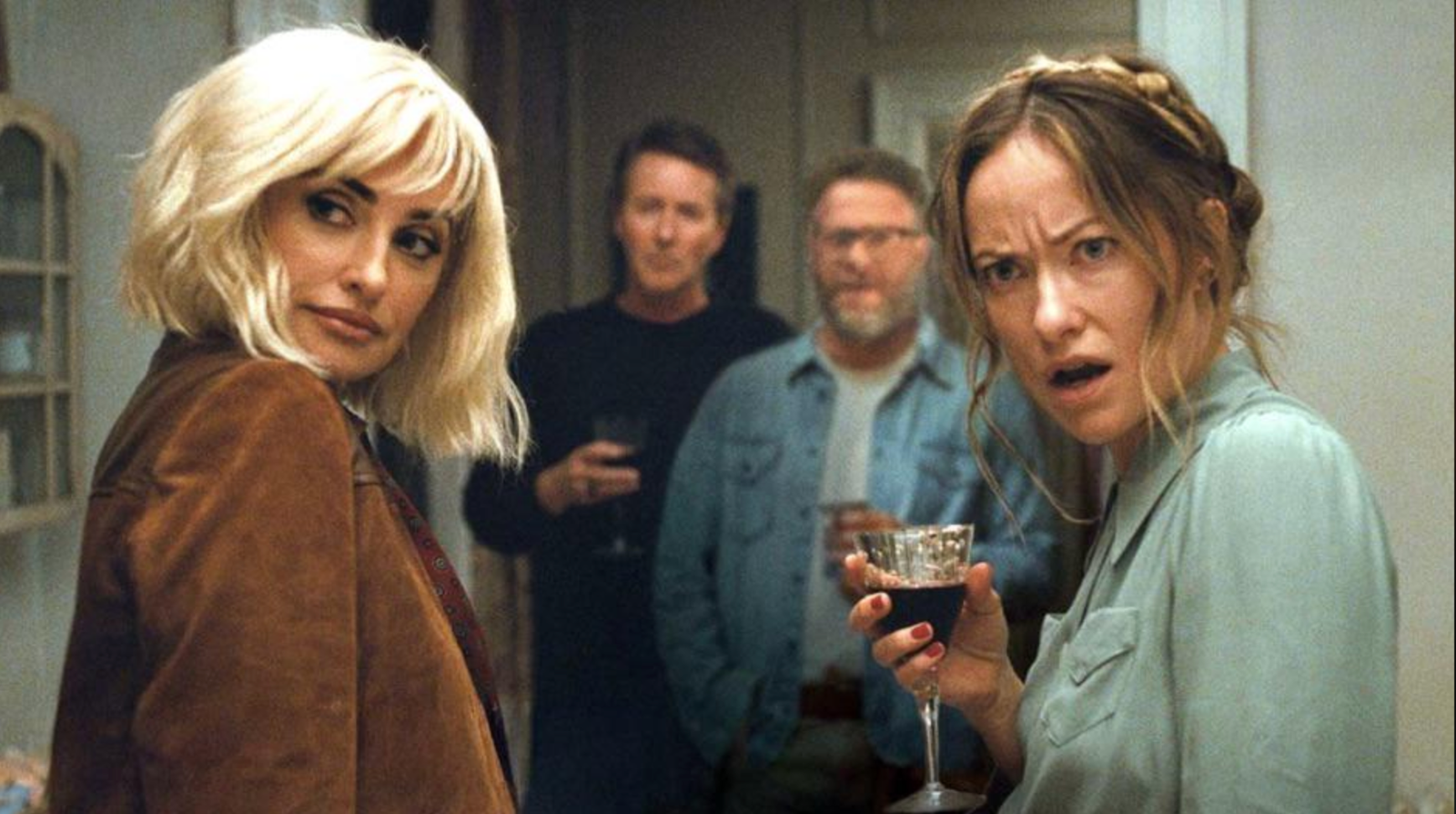
In Hawk and Piña – the upstairs neighbors – we have two open, confident, mature, grounded, alive people. They know themselves and what they want. They are happy for each other. They fight and lose control of themselves, but they also assume responsibility and repair quickly. They represent what Joe and Angela could have become.
The Two Couples of The Invite: Joe and Angela vs Hawk and Piña
From one point of view, Joe and Angela are up against difficult circumstances. Joe is a failed musician working a job he hates. Angela is a stay-at-home mom who left her true passion behind. Joe sees himself as worthless and undesirable. Angela sees herself as sacrificial and unappreciated.
But they fail to notice that the way they respond to their circumstances and to each other converts their difficulties into misery.
Joe deals with his life through aggressive self-absorption. He goes inward, focuses on his failures, and attacks himself. He blinds himself to all that his wife does for him. He denies himself his desires. He marries himself to the idea that he is pathetic. He chooses to see himself as a loser and to wallow in that view.
Angela deals with her life through anxiety-ridden, frantic action. She spends all day rushing from one chore to the next. She ties her identity and worth and belonging to motherhood, finding solace in her relationship with her daughter, fearing neurotically for her daughter’s eventual departure. She strives for the illusion of perfection. For her, appearance is everything. She sweeps her pain and her problems under thrift-store rugs and bathroom tiles.
In brief, Joe retreats from life while Angela races around it. He collapses inward. She throws herself into activity and decor. Neither of them face reality.
And, of course, they both blame each other. They make themselves out to be the victims of one another. Angela convinces herself that her misery is a product of Joe’s misery. Joe convinces himself that his depression is at least in part a product of Angela’s lack of interest in him as a man.
And so, lo and behold, their mutual misery magnifies and maximizes, until it becomes the murky, mucky marital mud they marinate in.
Enter Hawk and Piña.
We don’t get the privilege of learning Piña’s story. But she carries herself with a casual confidence that points to self-knowing and self-acceptance. She is knowingly abrasive, self-possessed and self-assured. Unapologetic and liberated.
And Hawk has been through hell, some of which he created. We learn that he once denied and suppressed the desires of someone he loved, and then had to live with losing her. Rather than organize the rest of his life around guilt and grief, he allowed the experience to change him. He became an open, expressive, appreciative, caring, non-defensive, curious man.
Neither of them are perfect.
The difference is that they don’t avoid pain and conflict and jealousy and disappointment and regret. They take an honest look at themselves. They confront themselves. And they accept and work on themselves.
Four Capacities of Emotional Maturity The Invite Reveals
There are four capacities of maturity exemplified by Hawk and Piña that Angela and Joe decidedly lack: Relationship with Reality, Self-Ownership, Tolerance of Desire, and Love without Self-Abandonment.
Each of these four pillars of maturity have their opposing, immature, defensive correlate.
Facing Reality vs Living in Denial
Joe and Angela are unhappy and dissatisfied, but largely living in denial. They can’t say in a reasoned, emotionally-regulated manner, “Our marriage is bad. I’m lonely and unhappy. My life did not work out the way I wanted, and I feel immense pain about that.”
It’s true that emotionally-laden and provocative statements come out in the heat of the moment (“I’m miserable, nobody sees me”) but they are used as weapons and means of avoiding self-confrontation.
These defensive moves allow them to avoid an immediate experience of emotional pain. But they also become the means by which their suffering compounds and calcifies.
On the other hand, Piña and Hawk have sat with the reality of their pain and discomfort. They have confronted their jealousy. Hawk has dealt with his grief and his remorse. We have to imagine that Piña has faced enough feeling material to enable her to live life on her terms.
In short, maturation involves a willingness to feel immense emotional pain (grief, guilt, uncertainty, remorse, rejection, hatred, rage, fear, hurt) without defensive avoidance.
Self-Ownership vs Blame
Self-ownership means self-acceptance and self-assuredness; a capacity to assume personal responsibility and to own the errors of our ways. It results in feelings of empowerment and increased capacity and potential.
Projection of responsibility, on the other hand, is marked by the urge to blame people and circumstances for one’s position in life. It inevitably leads to feeling like a powerless victim.
Self-ownership is always a painful pill to swallow.
It demands that we see how our current circumstances and emotions are largely a result of our choices and behaviors. We have to admit to ourselves that somebody else in a position similar to our own could have done much better.
Let’s take a look at what ownership versus blame/projection of responsibility sounds like:
- I am unhappy (ownership) –> You are making me miserable
- I’m sexually insecure (ownership) –> You make me feel undesirable (this is why Piña’s question to each of them – “would you fuck yourselves?” – was so good)
- I regret my sacrifices (ownership) –> You took my life from me
- I am invested in seeing myself as a loser and you can’t make me change my mind (ownership) –> I’m a failure
- I don’t feel appreciated or seen, I should do something about that (ownership) –> Nobody appreciates me
Self-ownership does not involve letting other people off the hook and certainly doesn’t involve self-admonishment. It’s simply recognizing that I have played no small role in my life turning out the way it has, and that the next decision I make is mine alone.
This is the basis for personal empowerment; which, in turn, is the basis for relational empowerment.
Further, I don’t think we can make a new choice in a new direction until we take responsibility for the choices we’ve already made.
So long as we deny our agency, we can’t seize our agency and use it to our advantage.
But if we can say, “I chose this. Perhaps under pressure. Perhaps without understanding the consequences. But I chose it and I’m choosing it,” then we enable ourselves to choose something different.
Tolerating Desire vs Denying What We Want
This is the main message of The Invite.
The movie uses the motif of shame-free sexual liberation in the form of orgies to exemplify radical acceptance of one’s desires. Piña and Hawk have clearly explored, accepted, and given freedom to this part of themselves. Angela and Joe, on the other hand, are in disbelief that two people can be so unabashed about their wants.
With wide-eyed awe they encourage Piña and Hawk to share more. Eventually, the opportunity to relish in their own sexual desires is presented to them on a silver platter. With uncomfortable awkwardness, Angela and Joe move towards previously taboo and repressed sexual exploration.
Until, that is, Joe sabotages it.
The viewer might dismiss Joe’s fall as simple bad luck. But psychologically, it is almost too perfect: even when reality contradicts his belief that nobody could possibly want him, Joe finds a way to preserve the belief. By injuring his back while taking off his pants, his depression and non-existent self-esteem prevail. They will not let him have what he wants.
And Angela, though disappointed, is probably relieved. Change is hard, excruciatingly so. Familiar misery is, for many people, vastly preferable.
After they sabotage their sexual exploration, the movie comes to a different sort of climax, as all of their very worst insults and views of one another are unleashed with reckless abandon.
The message is clear: courageous ownership and pursuit of desire (which comes on the heels of self-knowledge) liberates. It reduces resentment and encourages respect. It is the portal via which people emerge from the dungeon of despair into the vibrancy of life. And it is hard to tolerate. Joe and Angela are not capable of doing so.
Love Without Self-Abandonment
When we abandon ourselves to make way for relationship, resentment and depression build. An ideal relationship strikes a healthy balance between self-assertion with care for the other.
Piña and Hawk seem to have achieved some degree of this. They encourage one another in the pursuit of their wants, but not to the point of self-abandonment. If it becomes too much for either one of them to handle, it seems that they will make that clear and that the other will stop.
And when they hurt one another, they repair quickly. They know how to stop a rupture from turning into a full-on battlefield. In RLT, this is the difference between a rupture and a rift, and repair speed predicts more about a couple’s future than conflict frequency does.
Joe and Angela, however, both sacrifice too much of themselves, likely in the hopes of avoiding open conflict. This means they abandon their passions and dreams and pursuits and sexuality. They confine themselves to the stale status-quo. Rather than risk honesty, they suppress awareness. Rather than assert themselves and, in so doing, open themselves to rejection, they deal in passive-aggression.
In abandoning themselves as individuals, they abandon one another and they abandon the relationship as a whole.
On the other hand, because Piña and Hawk have the guts to be who they are, they allow the other to take them as they are or to leave them where they are. In this case, they are a good, honest match.
The Invite Ending Explained
And yet, for all their misery, the movie leaves Joe and Angela with a chance.
It is not a particularly good chance. These are deeply entrenched patterns and most people prefer a painful pattern to a challenging change. But there is a thin ray of hope.
After the blow-up, Hawk and Piña disappear from the scene. Joe suggests he sleeps in his office. Angela goes to the bedroom.
But then…
Instead of going directly to sleep, Joe opens his cherished, unused piano. And, carefully, with some degree of reservation, he plays it.
He makes a new choice. He gives expression to a long-buried part of him.
And Angela joins him. Rather than disappear into her own world, she moves towards him. She connects with Joe as he connects with himself.
It is a small moment. Laughably small compared to the scale of their problems. But perhaps that is the point. A new life does not arrive all at once. It begins with a new choice. A small one. And then another one.
The orgy wasn’t the real invitation.
The real invitation was to want. To feel. To acknowledge. To tell the truth. To take responsibility. To stop blaming. To open. To be vulnerable. To become themselves. To see one another without filters. To give each of them a chance to choose – or not to choose – each other.
And, in the closing scene, they accept it.
Joe and Angela’s patterns are not unusual. Most couples I work with are living some version of this; two people who have stopped facing themselves, and in doing so, stopped being able to reach each other.
Change is the product of new choices, done repeatedely. Small, specific, and made in the moment. Such as Joe opening the piano or Angela crossing the room.
If you recognize something of yourself or your relationship in this, you can schedule a free intake call, get in touch, or learn more about couples therapy.
Share with your community!